

If you have been asking "how do I grow my pest control business?", the short answer is this: stop selling treatments and start selling plans, pack your routes tight, and make sure the homeowners in your service area find you before they find anyone else.
Pest control is one of the best business models in home services because it is built on recurring revenue. A customer who signs a quarterly plan is worth many times what a one-time ant treatment brings in. The fastest-growing companies build everything, from their sales script to their marketing, around that fact.
Here are seven moves that work, in the order we would tackle them.
1. Make the recurring plan your real product
Treat the first treatment as a trial and the plan as the thing you actually sell. One-time jobs pay the bills this week. Recurring agreements build a company you can forecast, staff, and eventually sell.
The industry agrees on where growth comes from. In Pest Management Professional's 2026 State of the Industry survey, operators ranked referrals, customer retention, upselling, and repeat business as their top four opportunities. Every one of those depends on a customer base that stays.
What to do:
- Build clear tiers. A basic quarterly general pest plan with free re-treats between visits, then add-ons for mosquito, rodent, or termite.
- Present the plan on every first visit. The best time to offer it is right after the customer sees the problem solved.
- Keep the pitch simple. Unlimited re-service, year-round protection, and one predictable price instead of surprise calls.
- Automate the follow-up. A text and email sequence after the first visit will convert customers your techs did not close on site.
- Track the number. Know what percent of first-time customers become plan customers, and work to move it every month.
2. Build route density
Twenty customers in one neighborhood are worth far more than twenty customers spread across a county. Less windshield time means more stops per tech per day, and that is where margin comes from.
Density is also a marketing decision. Where you advertise decides where your trucks end up driving.
What to do:
- Work the neighbors. Door hangers, yard signs, and a neighbor discount on every street where you already have a customer.
- Aim your marketing at the zip codes you want. Geo-target your ads and build location pages for the neighborhoods where you are already strong.
- Say no to bad geography. A customer forty minutes outside your core area costs more than they pay.
- Reward referrals. Operators named referrals their number one opportunity for a reason. Ask every happy customer, and make it worth their while.
3. Win local search
Nobody plans to hire a pest control company. They see ants in the kitchen or hear something in the attic, grab their phone, and call one of the first names that shows up. If that is not you, the rest of this list does not matter much.
This is the work RedBrick does every day for home services companies, and the playbook is consistent.
What to do:
- Treat your Google Business Profile like your storefront. Correct categories, every service listed, real photos of your team and trucks, and new reviews every week.
- Run Google Local Services Ads. They sit at the very top of the results, and you pay per lead instead of per click.
- Build a page for every pest and every city. "Termite treatment in Marietta" and "mosquito control in Roswell" are different searches and deserve different pages.
- Plan content around the season. Termite and ant pages need to be ranking before spring. Mosquito pages need to be ranking before summer. SEO takes months, so start early.
- Ask for reviews systematically. An automatic request after every successful service beats asking when you remember.
- Be the answer in AI search. Homeowners now ask AI tools who to call. Businesses with clear service pages, consistent listings, and strong reviews are the ones that get recommended.
4. Market for plan starts, not phone calls
A marketing report full of clicks and calls tells you almost nothing. What you need to know is how many new recurring customers each channel produced and what each one cost.
That changes how you spend. A channel that brings cheap one-time wasp jobs can look great on a lead report and still lose to a pricier channel that brings quarterly plan customers.
What to do:
- Track every lead to its source. Call tracking and form tracking are not optional.
- Measure cost per plan start. Compare what you paid to acquire a customer against what a plan customer is worth over several years.
- Respond in minutes. The first company to answer usually wins the job. Use instant text-back and after-hours booking so no lead waits until morning.
- Send paid traffic to pages built to convert. A click on a termite ad should land on a termite page with a clear offer, not your home page.
- Budget on purpose. Set marketing as a percent of revenue, raise it when you want to grow faster, and hold it accountable to plan starts.
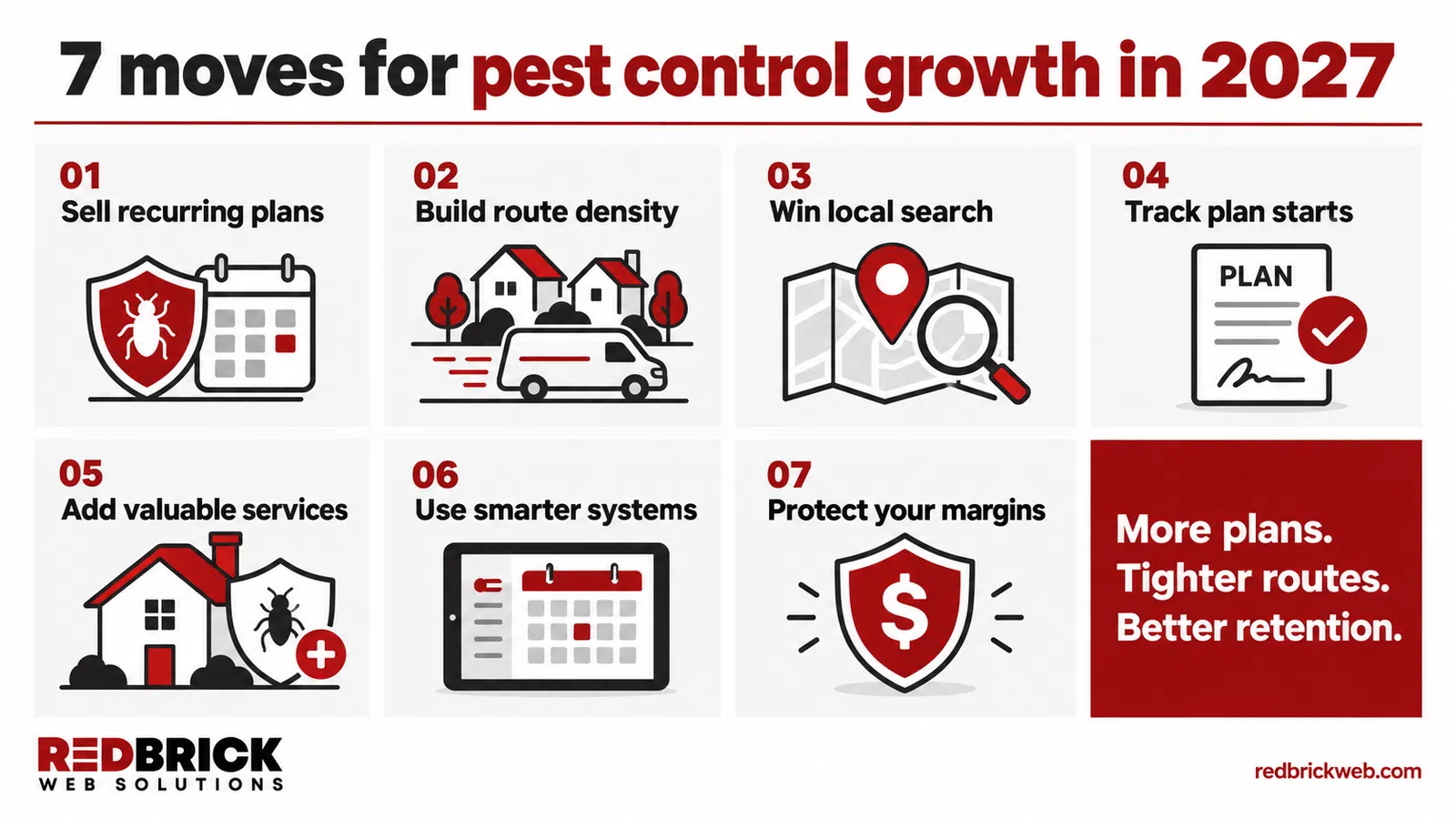
5. Add services that raise revenue per customer
The cheapest growth you will ever find is selling more to customers you already have. In PMP's survey, 69 percent of operators expected their add-on service revenue to increase in 2026.
The same survey ranked the most profitable add-ons. Mosquito control came first, followed by rodent exclusion, wildlife control, termite monitoring and baiting, and bed bug treatments.
What to do:
- Start with mosquito. It is seasonal, recurring, and easy to bundle into an existing plan.
- Add exclusion work. Rodent and wildlife exclusion are high-ticket jobs your techs can spot during routine visits.
- Upsell on the route. Sell new services to current customers before you chase new markets.
- Look at commercial. Restaurants, apartments, and warehouses mean larger contracts that tend to stick.
- Give each service its own page. Every add-on is a new set of searches you can rank for.
6. Use software and numbers to scale without chaos
Growth breaks companies that run on whiteboards and memory. The operators pulling ahead are the ones who invested in their systems.
FieldRoutes' 2026 industry report, a survey of more than 1,000 operators, found that planned investment in new software more than doubled year over year, and AI became the most anticipated technology for the next one to three years.
What to do:
- Run on real field service software. Route optimization, mobile apps for techs, digital agreements, automated reminders, and a customer portal.
- Let routing software plan the day. Fewer miles means more stops.
- Automate the office. Lead intake, appointment reminders, review requests, and win-back messages should run on their own.
- Review five numbers every month: callback rate, revenue per technician, stops per tech per day, retention rate, and recurring revenue as a share of total revenue.
7. Protect your margins
Revenue growth means little if costs grow faster. Operators told PMP that material and equipment costs, labor costs, and inflation are their top three obstacles, and FieldRoutes found material costs topping its risk rankings for the first time.
What to do:
- Keep your good techs. Fair pay, good tools, and clear processes cost less than constant hiring and retraining.
- Drive callbacks down. Every callback is a free visit. Training and proper application are the fix.
- Raise prices with confidence. If you deliver results and back them with a guarantee, most customers will stay through a fair increase.
- Grow where you are dense. Put your marketing dollars and your capacity where your routes already run.
Choosing a marketing partner for your pest control company
Moves three and four are where most owners need help, and where a lot of them have been burned. Before you sign with any agency, ask four questions:
- Who owns the website, the ad accounts, and the data? If the answer is not you, walk away.
- How long is the contract? A good agency keeps clients with results, not paperwork.
- What do the reports measure? Rankings and clicks are not booked jobs or plan starts.
- Do they know home services? Seasonality, service areas, and Local Services Ads work differently than marketing for a law firm or an online store.
RedBrick Web Solutions was built around those four answers. We call it the anti-agency approach:
- No long-term contracts. We earn your business every month.
- You own everything. Your site, your ad accounts, and your data stay yours.
- Reporting tied to outcomes. We report on leads and booked revenue, not vanity metrics.
- Home services is our specialty. SEO, PPC, and web design for contractors and franchise brands, backed by more than a decade of experience.
Where to start
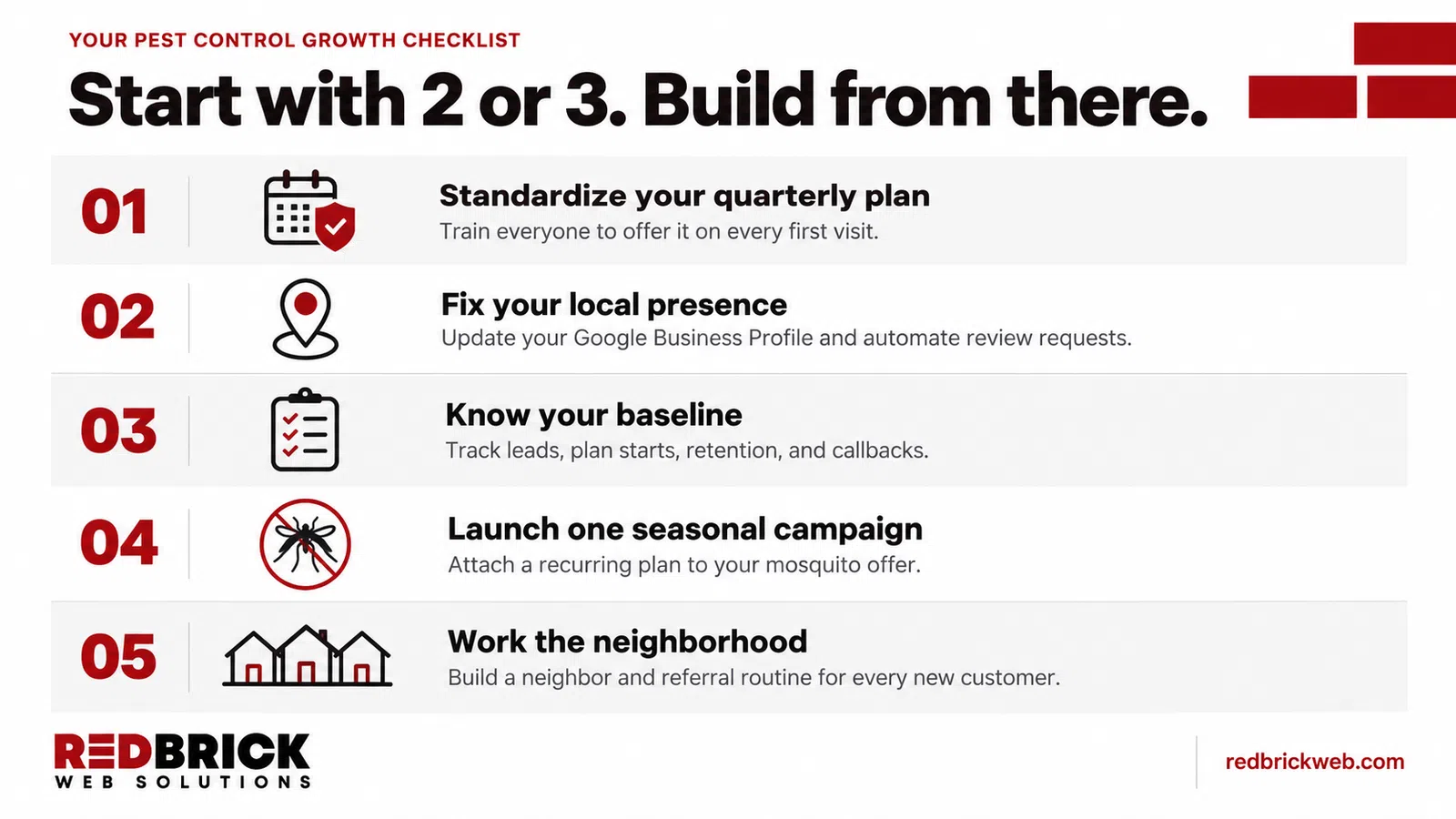
Pick two or three of these and do them well before you add more:
- Standardize one quarterly plan and train every tech and office employee to offer it on every first visit.
- Fix your Google Business Profile and set up an automatic review request after each service.
- Start tracking leads, plan starts, retention, and callbacks so you know your baseline.
- Launch one seasonal campaign, such as mosquito, with a recurring plan attached.
- Build a neighbor and referral routine for every new customer.
Growth in pest control compounds. More leads, a higher plan conversion rate, tighter routes, and better retention each make the others more valuable.
Ready to grow your pest control business? Talk to RedBrick Web Solutions about your local search presence. No long-term contract, and everything we build is yours.


