

Growing an HVAC business in 2027 depends on adapting faster than the shop down the road. The easy growth of the last few years, when demand outran supply and almost any contractor could stay busy, is over. What replaced it is a market shaped by new refrigerant rules, electrification, smarter equipment, and a technician shortage that is not going away.
That sounds like bad news. It is actually the opposite. Each of those pressures raises the bar for your competitors, and the contractors who clear it first get better customers, better margins, and better techs.
Here are eight moves that will matter most in 2027, and what to do about each one.
1. Lead with heat pumps, and sell the math
Heat pumps are now the default replacement conversation, not a niche upsell. Manufacturers shipped 3.64 million air-source heat pumps in the U.S. in 2025 against 3.25 million gas furnaces, according to AHRI year-end data. That happened in a down year, when combined AC and heat pump shipments fell 20%.
The sales pitch has changed, though. The federal 25C tax credit, worth up to $2,000 on a heat pump, ended for installations after December 31, 2025. Your reps can no longer lean on a federal check to close the gap on a higher installed price.
What to do:
- Train reps to sell total cost of ownership. Show monthly operating cost, not just the install price.
- Know every local incentive. State, city, and utility rebates now carry the weight the federal credit used to. Build a one-page cheat sheet for your service area and update it quarterly.
- Offer dual-fuel as the bridge. A heat pump paired with a gas furnace is an easier yes for homeowners who are nervous about cold snaps.
- Get ready for replacements. Manufacturers like Bosch expect the replacement cycle to pick back up in late 2026 and into 2027. Be staffed and stocked before it does.
2. Turn refrigerant readiness into a selling point
The move away from R-410A is done being a future problem. New equipment runs on lower-GWP A2L refrigerants like R-454B and R-32, and that means new tools, new safety practices, and new training for every tech who touches a system.
Most contractors treat this as a compliance cost. The smarter play is to market it. Homeowners with an aging R-410A system are confused about what they can repair, what they should replace, and what it will cost. The contractor who explains it clearly earns the job.
What to do:
- Certify the whole team, not just your lead installers.
- Stock for it. Supply has been easing, but the shop with equipment on hand wins the emergency replacement.
- Publish plain-English content. A page titled "Should I repair or replace my R-410A system?" answers the exact question your customers are typing into Google.
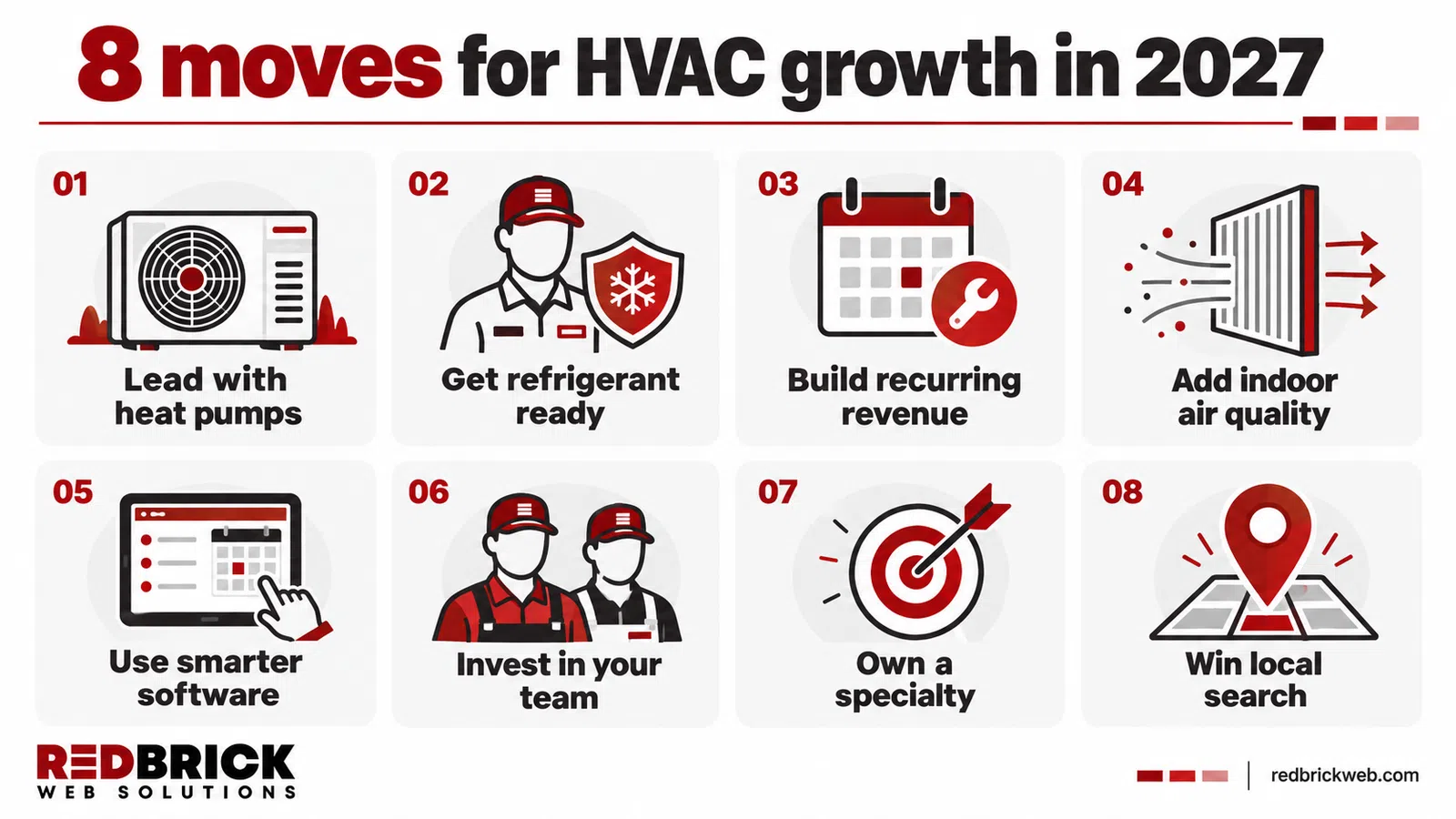
3. Build recurring revenue before you need it
A maintenance membership base is the most valuable asset an HVAC company can own. It smooths out the shoulder seasons, keeps techs busy, and puts you first in line when a member's system finally fails.
The model is also getting more ambitious. Subscription and "HVAC-as-a-Service" plans, where the customer pays monthly instead of buying equipment outright, are gaining ground, especially in commercial work. You do not need to go that far to benefit from the idea.
What to do:
- Set a membership target. Pick a number of active agreements for the end of 2027 and track it weekly like you track revenue.
- Offer the plan on every call. Most shops with weak membership numbers have an asking problem, not a pricing problem.
- Tier it. A basic tune-up plan, a mid tier with priority service and repair discounts, and a premium tier with monitoring or IAQ included.
- Pair replacements with a plan. A new system sold without a maintenance agreement is a customer you may never see again.
4. Make indoor air quality part of every ticket
Indoor air quality is the easiest way to raise your average ticket without adding a single new lead. Homeowners care more about what they breathe than they did five years ago, thanks to wildfire smoke, allergies, and general health awareness.
Filtration, UV, purification, ventilation, and humidity control all fit naturally into work you are already doing.
What to do:
- Add an IAQ check to every maintenance visit. Give techs a simple script and a simple good, better, best menu.
- Bundle it into replacement quotes. It is far easier to add IAQ to a new system than to sell it alone later.
- Sell comfort and health, not equipment. "Fewer allergy flare-ups" lands better than a model number.
5. Use AI and software to get more from the team you have
You probably cannot hire your way to growth in 2027, so you have to get more out of every truck. That is where technology earns its keep.
Smart thermostats, connected equipment, and remote diagnostics are moving from extras to expectations. On the back end, field service software and AI tools now handle scheduling, dispatch, call answering, and follow-up that used to eat hours of office time.
What to do:
- Fix dispatch first. One more completed call per tech per day changes your whole year.
- Answer every call. AI answering and booking tools mean a lead that comes in at 9 p.m. no longer goes to whoever picks up first the next morning.
- Offer monitoring. Connected systems let you spot problems early and turn a breakdown into a scheduled visit. That is a strong premium membership feature.
- Automate follow-up. Unsold estimates, review requests, and tune-up reminders should go out without anyone remembering to send them.
6. Treat hiring and retention as a growth strategy
The technician shortage is the real ceiling on most HVAC companies. The Bureau of Labor Statistics projects about 40,600 openings for HVAC mechanics and installers every year over the decade, many of them to replace techs who retire or leave the trade.
Every competitor is fishing in the same shrinking pond. The companies that grow are the ones techs want to work for.
What to do:
- Keep the techs you have. Pay, a clear career path, and a culture people do not want to leave cost less than constant rehiring.
- Grow your own. Apprenticeships and trade school partnerships take time, so start now.
- Market to recruits like you market to customers. A real careers page, tech testimonials, and recruiting ads are all part of the job.
- Specialize. Techs trained in heat pumps, A2L, and controls are worth more to you and harder for others to poach when you invest in them.
7. Pick a niche where the growth is
The fastest-growing corner of HVAC right now is data center cooling, driven by the AI buildout. It demands precision cooling, high uptime, and long-term service contracts. If you already do commercial work and you are near a data center hub, it is worth a serious look.
For most residential contractors, that is not the right move, and that is fine. The lesson is the same: specialists beat generalists.
What to do:
- Choose one or two lanes to own. Light commercial, VRF, ductless, cold-climate heat pumps, or high-end IAQ are all options.
- Build proof. Case studies, photos, and reviews tied to that specialty.
- Say it everywhere. Your website, your trucks, and your Google Business Profile should make the specialty obvious.
8. Own your local search presence
None of the first seven moves pay off if homeowners cannot find you. When an AC dies in July, the search starts on a phone, and the contractors at the top of the map and the search results get the call.
This is also where all the trends above become marketing. Every one of them is a question your customers are already asking.
What to do:
- Treat your Google Business Profile like a storefront. Accurate services, fresh photos, and a steady stream of new reviews.
- Build a page for each service and each city you serve. One generic "Services" page will not rank for "heat pump installation" in the next town over.
- Answer the 2027 questions. Heat pump vs. furnace costs, local rebates, the refrigerant change, and air quality all make strong content that ranks and sells.
- Show up in AI answers. More homeowners are asking AI tools for recommendations. Clear, specific, well-reviewed businesses are the ones that get named.
- Run paid search with discipline. Bid on the high-intent jobs you want, send traffic to pages built to convert, and track booked jobs instead of clicks.
- Own your assets. Your website, ad accounts, and data should belong to you, not your agency. If they do not, fix that before you spend another dollar.
Where to start
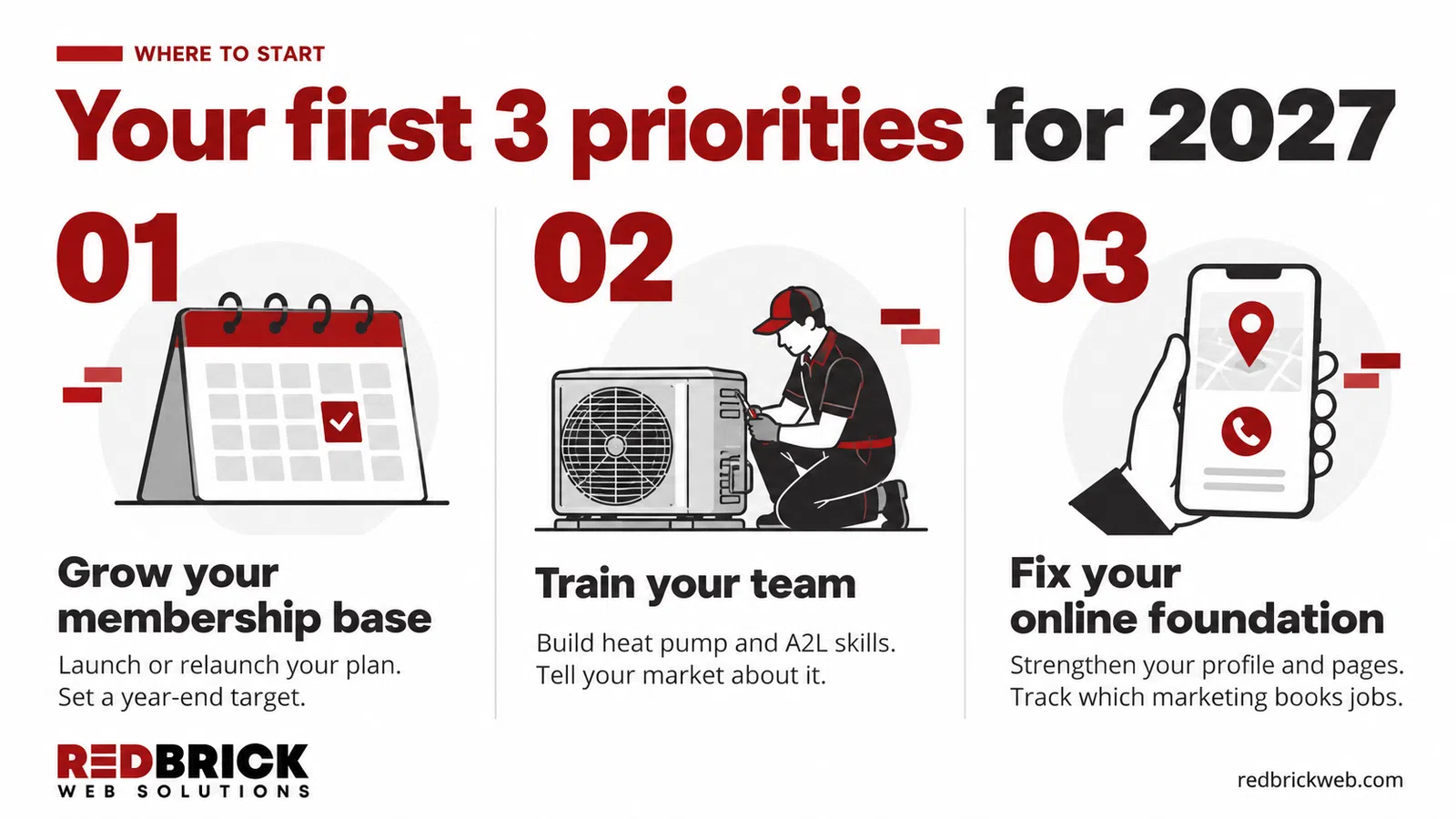
You do not need to do all eight at once. If you only have room for three priorities going into 2027, make them these:
- Launch or relaunch your membership plan and set a year-end target.
- Get your team fully trained on heat pumps and A2L refrigerants, then tell your market about it.
- Fix your online foundation: Google Business Profile, service and city pages, and call tracking so you know which marketing actually books jobs.
The contractors who win in 2027 will not be the ones with the biggest ad budgets. They will be the ones who treated these changes as permanent and built their business around them.
Want a second set of eyes on your marketing? RedBrick Web Solutions works with HVAC and home services contractors on SEO, PPC, and web design, with no long-term contracts and full ownership of everything we build for you. Reach out for a free review of your local search presence.
Sources
Checked October 10, 2026:
- AHRI 2025 year-end shipment data, via Contracting Business
- ACHR News: Heat Pump, A/C Shipments See 20% Declines in 2025
- BLS Occupational Outlook Handbook: HVACR Mechanics and Installers
- Trane: Energy Efficient Home Improvement Credit (25C) expiration
From the research file, not independently re-checked:


