
When a homeowner's air conditioner dies in the middle of July, they're not scrolling to page two of Google. They're calling one of the three companies in the Map Pack, that cluster of local business listings at the top of the search results.
For HVAC companies, ranking in the Map Pack isn't just nice to have. It's where the high-intent leads are, the ones ready to book service today. But getting there requires more than just claiming your Google Business Profile and hoping for the best.
Here are seven strategies that actually move the needle.
1. Get Your Google Business Profile Fundamentals Right
Your Google Business Profile is the foundation of your Map Pack ranking, and the basics matter more than most HVAC companies realize. Three elements are non-negotiable.
First, you need a legitimate physical location. Google heavily favors businesses with verified addresses in the areas they serve. If you're operating out of a P.O. box or virtual office, you're fighting an uphill battle.
Second, your primary GBP category needs to match your main service. If you primarily do AC repair and installation, "HVAC Contractor" or "Air Conditioning Contractor" should be your primary category, not something generic.
Third, consider your business name. If your company name doesn't include location or service keywords, a "Doing Business As" registration might be worth exploring. A company named "Atlanta Heating & Air" has a natural advantage over "Smith Services" when someone searches "heating and air Atlanta." This isn't about keyword stuffing, it's about legitimate branding that happens to align with how people search.
2. Think Strategically About Your Service Location
Google's algorithm heavily weights proximity to the searcher. When someone in Buckhead searches for AC repair, Google prioritizes businesses physically close to that area.
This is why choosing your office or shop location strategically matters. If you're leasing space anyway, consider where the highest concentration of your ideal customers lives. An address in a dense, affluent suburb often outperforms a cheaper space in an industrial park on the outskirts of town.
For HVAC companies serving multiple cities, this proximity factor is also why some businesses eventually open satellite locations, not necessarily for operational reasons, but for local search visibility.
3. Build Consistent Review Velocity
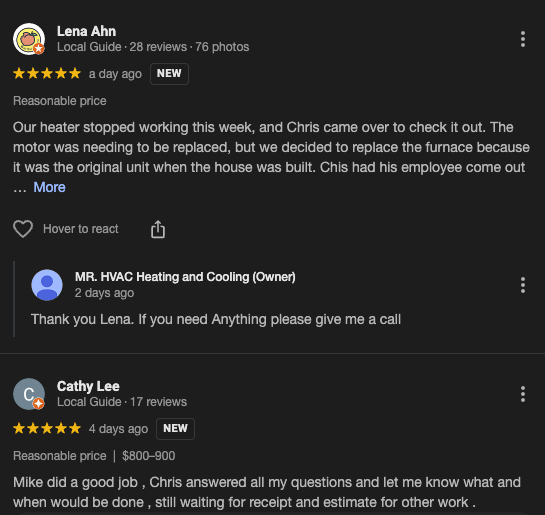
Reviews are one of the most powerful ranking signals for the Map Pack, but it's not just about total count. Google pays attention to how consistently you're earning new reviews.
A healthy target is 15 to 25 new reviews per month. This signals to Google that you're an active, established business that customers trust. Sporadic review activity, 30 reviews one month, then nothing for three months, doesn't carry the same weight.
Getting to 300 or more total reviews should be a milestone goal. Once you're there, the compound effect on your visibility is significant. But velocity matters more than hitting a magic number, so focus on building a systematic process for requesting reviews after every completed job.
Response time matters too. Respond to every review, positive or negative, within 24 hours. This shows Google (and potential customers) that you're engaged and attentive.
4. Ensure NAP Consistency Across Every Listing
NAP stands for Name, Address, and Phone Number, and consistency across every online mention of your business is critical. If your Google Business Profile shows "123 Main Street" but Yelp shows "123 Main St." and the BBB shows "123 Main Street, Suite A," Google's algorithm loses confidence in your data.
Start with the high-authority directories: Yelp, BBB, Angi, Apple Maps, and the major data aggregators. These citations carry real weight. Then work through industry-specific directories and local business listings.
Use exactly the same formatting everywhere. Same suite number format. Same phone number format. Same business name spelling. This consistency builds trust with Google's algorithm and reinforces your legitimacy as a local business.
5. Connect Your GBP to Location-Specific Landing Pages
Here's a mistake many HVAC companies make: they link their Google Business Profile directly to their homepage. While that's better than nothing, you're leaving ranking power on the table.
Instead, your GBP should link to a location-specific page, a page built specifically for your primary service area. If you're targeting Atlanta, that page should be optimized for Atlanta-specific searches, with relevant local content and clear calls to action for that market.
Take this further by building dedicated service area pages for each city or neighborhood you serve. A page targeting "AC Repair in Marietta" can rank for those specific local searches while supporting your overall Map Pack visibility. These pages should offer genuine value, not thin, duplicate content with city names swapped out.
6. Dial In Your On-Page SEO
Your website's technical SEO directly impacts your Map Pack performance. Google's algorithm looks at signals from your website to determine relevance and authority.
Start with the fundamentals: title tags, H1 headers, and meta descriptions on every service page should include your target keywords and service areas naturally. Your title tag might read "AC Repair & Installation in Atlanta | [Company Name]" rather than just "[Company Name] | Home."
Don't forget your secondary GBP categories. Fill these out completely to capture searches for related services. If you also do duct cleaning, water heater installation, or indoor air quality work, those secondary categories expand your visibility.
Add detailed service descriptions to your GBP with relevant keywords woven in naturally. And implement schema markup on your website, this structured data helps Google understand your business information, services, and service areas more clearly.
7. Build Local Authority Through Strategic Link Building
Links from other websites remain one of Google's strongest ranking signals, and this applies to local SEO as well.
Press releases are an underutilized tool for HVAC companies. A well-distributed press release about a company milestone, community involvement, or new service offering can generate links from news sites and industry publications.
Link insertions on relevant websites, getting your company mentioned and linked from existing content on local business sites, home improvement blogs, or community resources, build authority in your specific market.
Your internal linking structure matters too. Create logical connections between your service pages so that link equity flows throughout your site. Your homepage should link to main service pages, which should link to location-specific pages, creating a clear hierarchy that Google can crawl and understand.
The Map Pack Compounds Over Time
None of these strategies produce overnight results. But implemented consistently, they compound. Review velocity builds on itself. Links accumulate authority. GBP optimizations reinforce each other.
The HVAC companies dominating the Map Pack in your market didn't get there by accident. They invested in these fundamentals and maintained them over time. Start with the non-negotiables, layer in the high-impact optimizations, and the rankings will follow.


