
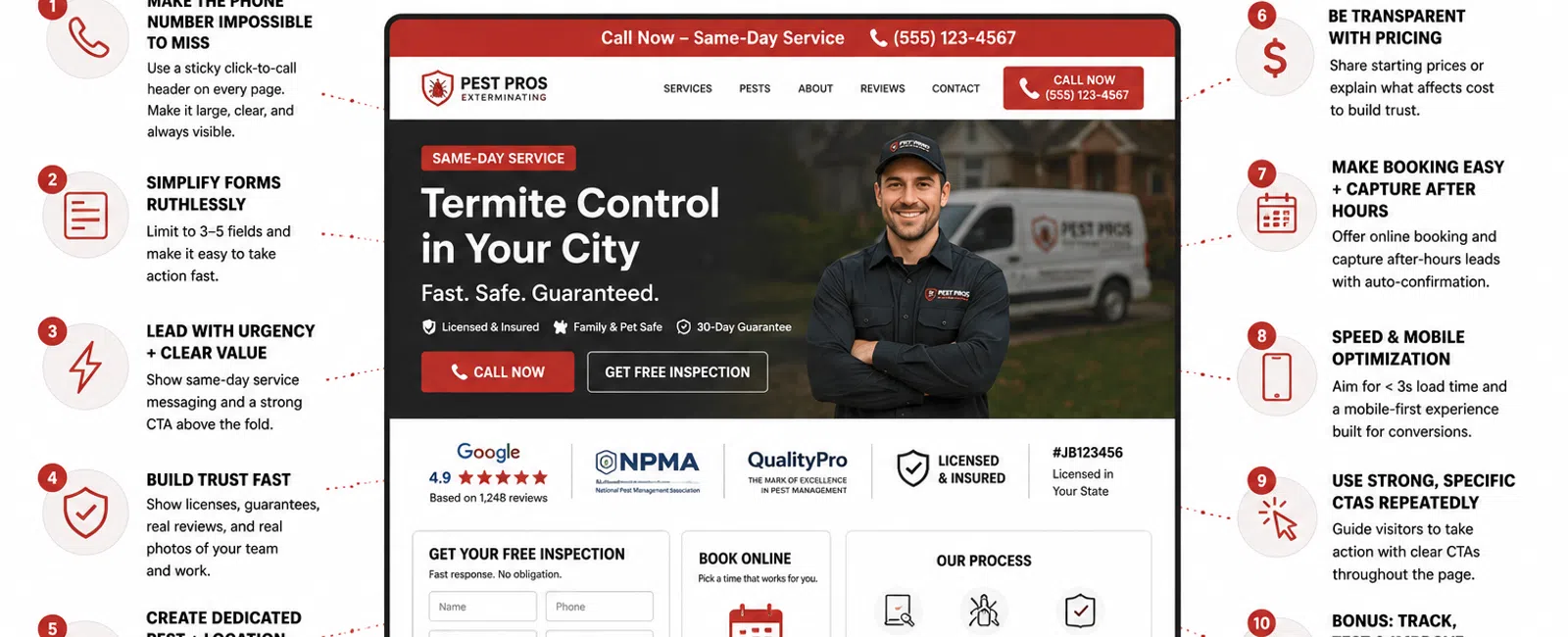
Your Website Gets Traffic. So Why Isn't the Phone Ringing?
Most pest control owners we talk to say some version of the same thing: "People are finding us. They're just not calling."
That's usually not a traffic problem. It's a website problem.
Here's the math nobody explains. Out of every 100 people who land on your site, some small number actually call you or fill out a form. For a typical pest control site, that's 3 or 4 people. The other 96 leave. If you can get that number to 8 or 10, you just doubled or tripled your leads without spending another dollar on ads or waiting six months for rankings.
That's the whole game. Below are the changes that move that number, ranked by how much they matter.
1. Put your phone number where nobody can miss it
This is the biggest single win, and it takes an afternoon.
Your number should sit at the top of every page, stay there while people scroll, and be big enough to tap with a thumb. Don't just show the digits. Say what they get: "Call Now: Same-Day Service."
Almost everyone searching for a pest guy is doing it on a phone, standing in the room with the problem. One tap should get them to a human. We've moved a phone number out of the footer and into a locked header and watched call volume jump the same week.
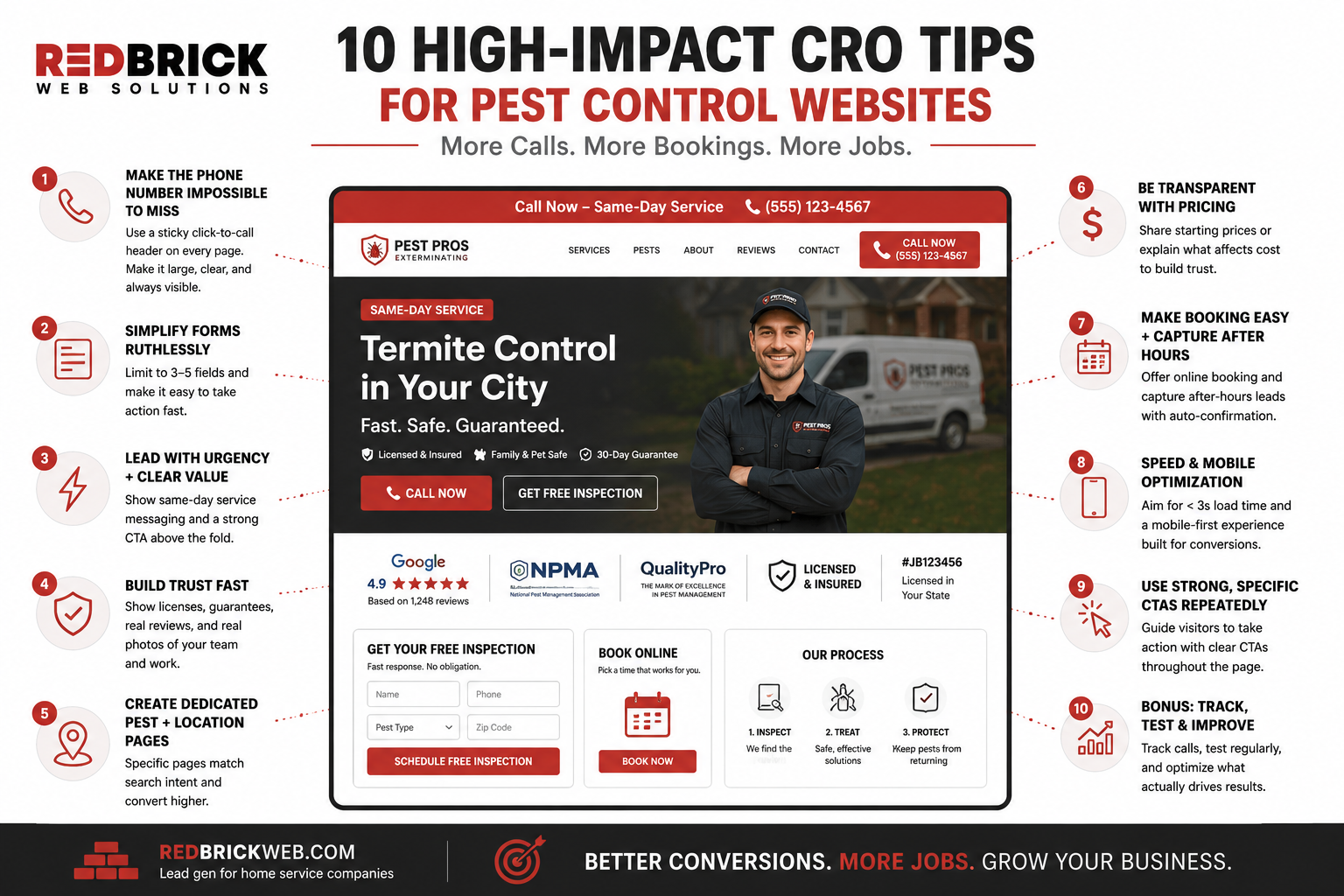
2. Stop asking for so much information
Three to five fields. Name, phone, zip code, and a dropdown for what kind of pest. Email is optional.
Every extra box you add is another reason for someone to give up. And remember who's filling it out: a person who just found mouse droppings behind the stove. They are not in the mood for a questionnaire.
Put that short form on your homepage and on every service page. Don't make someone hunt for a Contact page.
3. Say you can help today, right at the top
People decide in about five seconds whether you're worth their time. The top of your page has one job: answer "can you come out?"
Something like "Termite Control in Marietta: Same-Day and Emergency Service" does more than any slogan. Put a button right next to your phone number so people can either call or book, whichever they prefer.
4. Prove you're legit before they have to wonder
Your customers have two worries: the bugs come back, and the chemicals hurt their kids or their dog. Answer both before they finish reading.
Show your license number and "Licensed and Insured." Show your association logos. Show your guarantee in plain words: "If pests come back within 30 days, we treat again at no charge." That one sentence outperforms a page of adjectives.
Pull in your Google reviews live so people see the star rating and recent comments, especially ones that name the specific pest.
And use real photos. Your techs, your trucks, your actual before and after shots. Stock photos hurt you here. Somebody is about to let a stranger into their house. Show them who's coming.
5. Give each pest and each town its own page
One page that lists everything you treat will always lose to a page about the one thing somebody's searching for.
Build separate pages for termites, bed bugs, rodents, ants, mosquitoes, and wildlife. Then build pages for the towns you serve. On each one, explain the process, how long it takes, whether it's safe around pets and kids, roughly what it costs, and how to book.
This is where getting found and getting called stop being two different jobs. The specific page ranks better and converts better at the same time.
6. Talk about price
Show a starting price, a few package tiers, or at minimum a clearly labeled free inspection.
Then explain what moves the number: "Price depends on the size of the infestation and the size of your home." That costs you nothing and keeps a lot of people from leaving.
A big share of visitors bail the second they realize they have to submit a form and wait for a callback just to find out if this is a $200 job or a $2,000 job.
7. Catch the calls that come in at night
Bugs don't wait for business hours. Neither does searching.
Add a booking button that opens a simple scheduler. Set up an automatic confirmation so someone who books at 11pm knows they're actually on the list. Chat coverage for nights and weekends is worth testing too, because a Saturday evening lead is every bit as ready to buy as a Tuesday morning one.
8. Make your site fast on a phone
If your site takes more than three seconds to load, you're losing emergency calls. Google also factors speed into rankings, so this work never goes to waste.
Design for the phone first, make buttons big enough to hit, and test on an actual phone instead of your office desktop.
9. Make your buttons say what happens next
"Submit" and "Contact Us" are wasted space.
Use the outcome instead: "Schedule My Free Inspection." "Get Rid of Termites Today." "Call for Same-Day Service."
Then repeat the button every few sections. Top, middle, bottom. People make up their minds at different points, and you don't get to pick which one.
10. A few more that pay off
- Reviews with a real photo and the specific pest named
- An FAQ that handles the objections head on: is it safe, how long does it last, what happens on the day of service
- If you run Google Ads, send that traffic to a dedicated page that matches the ad, with the menu stripped down
- Call tracking numbers so you know which ads and pages are actually producing work
That last one isn't optional. Running ads without call tracking means guessing.
If you only have a week
Do these four, in this order:
- Lock your phone number to the top of every page
- Cut every form down to four fields
- Add same-day messaging and your guarantee to the top of the homepage
- Put your reviews and your license front and center
These changes routinely take a pest control site from 3 or 4 calls per 100 visitors to 8 or more. Same traffic. Same ad budget. More work on the board.
Most companies react to a slow month by buying more clicks. Fixing the website does the same thing to your lead count, except you pay for it once instead of every month.
The short version
It comes down to two things: make it easy, and make it believable. Somebody stressed out about bugs in their house needs to see in five seconds that you can come today and that you won't make it worse. Every item above is one of those two.
At RedBrick, we build home services websites around the numbers that matter: calls, booked jobs, revenue. No long-term contracts, and you own everything we build. If your site is getting traffic that never turns into work, let's take a look at the numbers together.


